

Social Economy and Community Wealth Building
Dimension Overview
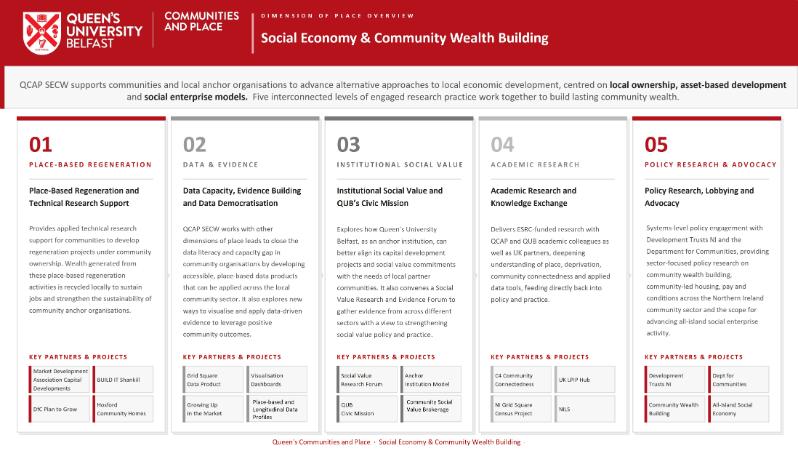
QCAP's Social Economy and Community Wealth Building work supports communities and anchor organisations to advance alternative approaches to local economic development, centred on local ownership, asset-based development and social enterprise models. The work operates across five levels of engaged research practice, which are summarised in more detail below:
Social Economy and Community Wealth Building Dimension Lead
Dr. Andrew Grounds - a.grounds@qub.ac.uk
1. Place-based Regeneration and Technical Research Support
QCAP provides hands-on, technical support to help communities develop regeneration projects that deliver the social infrastructure and services local people need and that they can own, control and benefit from directly. Central to this is the social economy principle that wealth generated within a community should be recycled back into it so that it can sustain local employment, create social value and build the long-term financial resilience of anchor organisations. QCAP works alongside community partners at different stages of development, from early-stage planning through to capital development and delivery. Current partnerships include the Market Development Association and their capital build programme, which is exploring how several community-owned regeneration projects can serve as a platform for wider community wealth creation; The BUILD IT programme and the Department for Communities-supported 'Plan to Grow' initiative, which are driving regeneration across the Greater Shankill through community-led planning and investment; and Hosford Community Homes, an innovative community-led housing model developed in partnership with East Belfast Mission to address homelessness through locally rooted, social economy solutions
2. Data Capacity, Evidence Building and Data Democratisation
A commitment to community wealth building requires communities to have access to high-quality, locally relevant data and the skills to use it. QCAP SECW works with other dimensions of place leads to close the data literacy and capacity gap in community organisations by developing accessible, place-based data products and building data literacy across the local community sector. This includes the Grid Square data product, which enables granular spatial analysis of deprivation and need at a neighbourhood level, as well as interactive data visualisation dashboards that translate complex datasets into actionable intelligence for community planners and decision-makers. Alongside these tools, QCAP SECW delivers capacity building support to help organisations move from data consumers to data producers, embedding a culture of evidence-led practice. This strand is further supported by QCAP's own longitudinal research study, Growing Up in the Market, which provides locally sourced, long-run insights into how place shapes life outcomes in one of Belfast's most distinctive communities.
3. Institutional Social Value Brokerage and QUB's Civic Mission
The third level of QCAP's work addresses the responsibility of Queen's University Belfast as a major anchor institution in its own right to generate and broker social value for the communities within its physical and civic footprint. Drawing on the same community wealth building principles that inform its community-facing work, QCAP is exploring how the University's procurement, employment, assets, investment and knowledge can be more deliberately aligned with the needs of surrounding communities. This work recognises that universities, like hospitals and local authorities, are significant economic actors whose everyday decisions have profound consequences for local wealth distribution. To drive this agenda forward, QCAP convenes a dedicated Social Value Research and Evidence Forum, a cross-sector platform bringing together representatives from the community, public and private sectors to critically examine current social value approaches, share learning and develop improved practice. The Forum reflects QCAP's broader conviction that meaningful change requires sustained, honest cross-sectoral engagement rather than one-off consultation.
4. Academic Research and Knowledge Exchange
QCAP's community wealth building agenda is underpinned and extended by a programme of externally funded academic research, conducted in collaboration with colleagues across Queen's University Belfast and partner institutions throughout the UK. This research deepens understanding of place, deprivation, community resilience and social economy models and generates engaged research and evidence that feeds directly back into practice and policy. Current ESRC-supported programmes include the C4 Centre for Community Connectedness, which explores how social infrastructure and relationships sustain community wellbeing; the Local Policy Innovation Partnerships (LPIP) Hub, which brings together policymakers, researchers and communities to co-produce locally responsive solutions; Maximising the Value of the 2021 NI Census: Adding Time to Place, which develops new methodological approaches to understanding how communities change over time; and the Northern Ireland Longitudinal Study (NILS), which tracks life course outcomes across the population and provides a vital evidence base for place-based policy. Together, these projects position QCAP at the intersection of academic rigour and community relevance.
5. Policy Research, Lobbying and Advocacy
Finally, QCAP works at a systems level to influence the policy environment in which communities and social enterprises operate, recognising that place-based change requires supportive frameworks at the regional and national level. This involves close collaboration with key intermediaries and government bodies, including Development Trusts Northern Ireland and the Department for Communities, to provide rigorous, practice-informed policy research across a range of interconnected themes. To date, these have included community wealth building strategies and their applicability to the Northern Ireland context; the enabling conditions for community-led housing to scale; the scope to develop a more comprehensive All-Island social enterprise sector; as well as the pay and working conditions challenges facing organisations across the Northern Ireland community sector. QCAP SECW’s policy work is grounded in the community voice and evidence, ensuring that advocacy is credible, place-sensitive and connected to the lived experiences of communities on the ground.