
Survey is Live - Please Consider Participating!
Studying the Impacts on Quality of Life for Parents/Caregivers of Fragile X, 22Q, Rett Syndrome and Angelman Syndrome.
.png)
This survey will help us to identify key themes among carers of these complex conditions. It will focus on the impacts on your health and how you feel about your caring responsibilities.
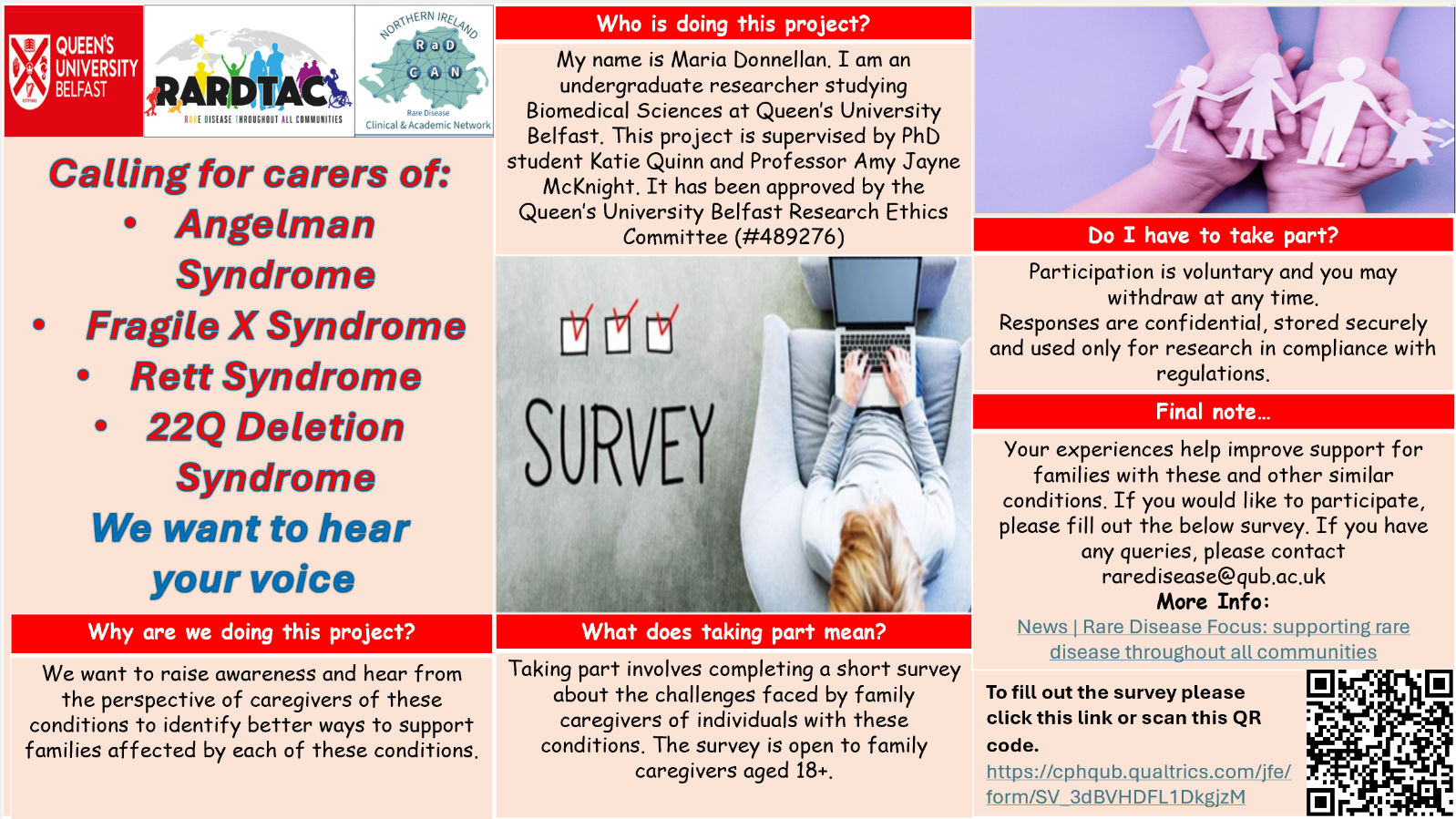
MORE INFORMATION ABOUT THE STUDY:
About this project
This project is being undertaken as an undergraduate project at Queen’s University Belfast.
Fragile X Syndrome, 22Q, Rett Syndrome and Angelman Syndrome are all rare diseases which are genetically different. However, they can display quite similarly and thus the impacts on primary caregivers could be similar. Similarities include verbal communication issues, social anxiety, and behaviours associated with autism spectrum disorder (ASD). As these are all rare conditions it is difficult to gather large numbers of caregivers to study the impacts of one condition in isolation.
What is the purpose of the study?
The aim of this survey is combining the lived experiences of family caregivers of people with one of these conditions. We want to study the impacts on the quality of life (QOL) of family caring for these conditions. We also want help raise awareness of these conditions and to give a voice to family caregivers who are often forgotten but who’s physical and mental health is extremely important for providing care to people suffering from these conditions.
Invitation to take part in the study
You have been invited to take part in the following survey as you are a caregiver providing care for someone with one of the following conditions: Angelman Syndrome, Fragile X Syndrome, Rett Syndrome or 22Q. This leaflet provides important information you will need to think about when deciding whether you would like to take part in this project. The information in this leaflet may be made available in other formats- please just ask. If you want more detailed information about something you can ask at any time. Please see some important details listed below:
Do I have to take part?
It is not compulsory for you to take part in this survey. You can take as much time as you need to decide if you want to contribute. If you do not want to participate you do not need to explain why. You may want to withdraw from this project and if you would like to do this there are two options:
1. No further contact from research group but continue to include my existing information in the project.
2. No further contact and no further use of the information I provided; all related details will be deleted.
What do I have to do?
Taking part in this project would involve filling out a short online survey which should take no longer than 20 minutes to complete. The survey will be split into 2 sections. The completed surveys will be stored in a safe environment that complies with national data security standards and will only be available to the researchers involved in the initial analysis. Original data obtained from this project will be permanently destroyed after five years. All future work will use summary data, which is anonymised.
How will the results be used?
Results from this project will be collated anonymously and will be used to study the first-hand impacts of caring for people with complex needs. We hope this project will help to raise awareness of the everyday and lifelong impacts on families living with and caring for rare conditions. This project will be written as part of a final year dissertation and will be published. Participants may optionally provide an email address if they wish to receive a summary of results. We hope this project will give a voice to people who have so often neglected their own needs due to their caregiving duties. Caregivers input is invaluable to this project. As the survey is anonymous, it will not be possible to withdraw data once the survey is submitted. Participants may exit the survey at any point before submission. Participants may optionally provide an email address if they wish to receive a summary of results.
Are there any risks or disadvantage to taking part in the project?
Some people worry that they will be identified from the research. The chance of this happing by anyone outside of the research team is low and data will be anonymised and stored in a secure location.
If a participant wishes to complain they can get in touch with the rare disease team, email: raredisease@qub.ac.uk.
If this survey causes discomfort participants are encouraged to get in touch with several available support services. For UK based participants: Genetic Alliance UK, email: contactus@geneticalliance.org.uk. For EU based participants: EURODIS (Rare Disease Europe), email: eurordis@eurordis.org.
For global based participants: Rare Diseases International (RDI), email: comms@rarediseasesint.org.
What are the advantages?
Taking part in this research will help to identify the real-life struggles that so many caregivers undergo and this will give an opportunity to not only give carers a voice but may contribute to tangible changes down in the line in the rare disease and caregiving communities.
Will my taking part in this project be kept confidential?
QUB takes data security very seriously. Survey data will be downloaded from Qualtrics and stored in a dedicated, private QUB Teams channel to which only Maria (undergraduate student), Katie (PhD student supporting Maria), and their academic supervisors have access. All analysis will be performed within this QUB Microsoft 365 environment. Data from the study will be also be stored in 2 encrypted hard drives which will be locked in a secure cabinet in the Molecular and Epidemiology (MEPH) Labs in in the Centre for Public Health (CPH) buildings for a period of 5 years; this is excellent research practice, enabling us to answer any questions that may arise as we seek to raise awareness of challenges experienced by caregivers in the coming years. Nobody outside this research project can access recorded or transcribed information; we will only share summative data that will go towards identifying priorities and improving rare disease resources. If anyone reveals your data on purpose in a way that identifies you, it is a legal breach (in other words, they have broken their contract or they have broken the law). Any person, institution or company that does this could face criminal charges or substantial fines.
What do I do next?
Click here if you are interested in completing the survey!
Contacts:
Rare Disease Research Lead:
Amy Jayne McKnight, a.j.mcknight@qub.ac.uk
PhD Student:
Katie Quinn, raredisease@qub.ac.uk
Rare Disease Team Queen’s University Belfast:
THANK YOU SO MUCH FOR TAKING THE TIME TO READ ABOUT, AND HOPEFULLY TAKE PART IN, THIS RESEARCH PROJECT.
Professor Amy Jayne McKnight
Media
Please do contact our rare disease team by email for further information.