
Seven Lessons from Agreement 25
Emily Bishko, LLM student, International Human Rights Law, Queen’s University Belfast.

Last week, I had the honor of attending Agreement 25, the international conference hosted by Queen’s University Belfast to mark the 25th anniversary of the Belfast (Good Friday) Agreement (“GFA”). Brokered by diametrically opposed political parties with support from U.S., U.K., and Irish governments, this 1998 peace accord is attributed with ending three decades of sectarian violence in Northern Ireland (“The Troubles”). As part of this, it codified Northern Ireland’s constitutional institutions and identity. Put briefly, it established Northern Ireland as a devolved UK nation on the island of Ireland with unique Irish/British identity sharing arrangements, including citizen access to either or both passports, free travel between the North and “South” (the Republic of Ireland), and the ability for democratic re-evaluation of this set-up.
Agreement 25 gathered relevant representatives, from then and now, to recognize the challenge of attaining the GFA, the 30-year conflict that preceded it, and its continued importance in Northern Irish society. The main agenda of the (packed) three-day event featured remarks from 10 heads of state, government, or international organizations; 36 other top government officials; 17 professors or academic fellows; 22 civil society leaders; and 2 student liaisons. Headliners included President Bill Clinton, Secretary Hillary Clinton, Prime Minister Rishi Sunak, Taoiseach Leo Varadkar, and the agreement’s multi-party negotiators, to name just a few.
In keeping with the convention’s theme of “reflect, renew, reimagine,” the leaders emphasized the importance of the Good Friday Agreement in sustaining today’s Northern Ireland and offered guidance for where to go for the next twenty-five years. Between their comments and the – dare I say – equally insightful debriefs with classmates and fellow conference-goers (all of whom are very impressive in their own rights), some themes emerged again and again, or captured enough insight they only needed speaking once. Here are some of the top takeaways I noted from the discussions:
#1: Peace and prosperity are linked. Multiple speakers, including the Agreement’s architects, today’s politicians, and professors, emphasized the tie between peace and prosperity. The conflict started within predominantly working class neighborhoods, where there was high unemployment (~12%, according to some conference speakers), few opportunities, and limited hope for a better future. The fighting reflected and re-enforced these conditions, and it took the cessation of armed hostilities to advance livelihoods. In turn, this advancement, along with concurrent constitutional settlements, ceasefire provisions, and conflict fatigue, sustains the ongoing armistice. It works: as I wander Belfast today, I could easily remain ignorant of the city’s past, even with continued walls and gate closures in some neighborhoods. Even so, tensions between communities remain, usually still along Protestant/Unionist (“We’re British!”) and Catholic/Nationalist (“We’re Irish!”) lines, usually still concentrated within working class areas. Paramilitaries have morphed from political forces to criminal gangs and drug traffickers. The conference’s speakers are all confident that widespread non-violence will endure, but they caution that relapses could return if economic and egalitarian conditions worsen. As Northern Ireland continues to shift and grow, it is necessary to make sure all its people can benefit from its successes; conflict started when conditions were poor and anger around discrimination rampant.
#2: Seize opportunities – and persevere. Within their reflections, almost every involved negotiator underlined that it was (very) uncertain that their efforts would yield a happy ending. They achieved because they chose to continue, often despite difficult opportunity costs. They also took advantage of opportunities presented by changing momentums, for instance, U.K., U.S., and Irish elections ~1997 and increased interest in Northern Ireland from the American public around that time. The GFA happened because participants decided they wanted it to, with contributors choosing to meet artificially-imposed deadlines, once emphasized. They identified their goals, took chances as they opened, and saw them through.
#3: The peace mediations worked because they created space for frank exchange, individualized attention, and therefore reciprocal trust. I saw for myself the importance of attention, acknowledgement, and interpersonal aid during a side-event featuring conflict victims who feel neglected by amnesty components of the GFA and more recent policy proposals; their pain was compounded by feelings of ‘going unheard’ and a lack of basic human decency (e.g., limited compassion during grim proceedings, long processes, hidden information, formalized victim-blaming).
#4: The Agreement worked because it was inclusive, comprehensive, for the people, and by the people. Multiple times throughout the week, it was stressed that the Good Friday Agreement was successful in enabling armistice because it was inclusive and comprehensive: it responded to the needs and concerns of political views across the spectrum, balancing them throughout negotiations and incorporating them within the GFA’s compromises. Again, this resulted from the environment negotiation chairs made efforts to maintain. In parallel, speakers emphasized that the Agreement was “for the people and by the people” of Northern Ireland. This gives recognition and responsibility for the GFA to local communities, motivating pride and a stake in its continued success. Creating such exhaustiveness and ownership requires time and (many) difficult conversations, but the GFA shows that successful agreements cannot be shortchanged and must be created with consideration, care, comprehension, and proper custody.
#5: Organize votes on what to move “to,” not on what to move “from.” Reflecting on lessons of Brexit, Naomi Long, Leader of the Alliance Party (the third largest political party in Northern Ireland, with liberal-centrist views), commented that “we should not have referendums without having a formal proposition that people can scrutinize.” Her comments responded to the longstanding complications of redefining UK-EU relations, but they also provide a suggestion for future island politics: how to raise the question of re-uniting all Irish counties, a possibility underlying the GFA. However, this is not the only place that deals with constitutional crises. Her suggestion to have elections on what to move “to,” not “from,” could potentially be useful in multiple situations, from Israel-Palestine territorial disputes to U.S. healthcare re-designs.
#6: Celebrations and criticisms can coincide. While much of the conference celebrated the GFA and its architects, criticisms were also present: of the GFA and missed opportunities, of the choice of who to recognize and not recognize during sessions, and of current issues within local politics. (Within contemporary criticisms, the loudest was a call to end the stalemate at Stormont, the devolved Northern Irish parliament.) In particular, panels on victims and current political debates made clear that, although the GFA underpins contemporary life and prospects in Northern Ireland, there are some who still resent certain concessions made. The conference reminded that compromise is often necessary but worthwhile. It also showed that successes can and should be celebrated, even with needed improvements outstanding.
#7: Politicians are people, too. In casual, academic, and media discourses, celebrities seem to become abstractions of themselves, with many recast as demons or heroes. It was refreshing to witness such famous figures in-action this week. Seeing past and present politicians interact with each other, take joy and support in their shared company and that of their partners, and enjoy and get fatigued by unending selfie requests was an important reminder that we all share basic needs and human emotions. Among other benefits, this conference seemed to provide the involved individuals catharsis through the opportunities for reflection and reunion. It is worth remembering that politicians’ distinct personalities and preferences almost certainly help shape the outcome of their processes; that conversations with them are fundamentally still conversations; and that anyone could one day work to fill similar shoes.
While Agreement 25 focused on Northern Ireland, its lessons for how to create and sustain peace and navigate turbulent times are widely applicable.
Originally from Atlanta, GA, Emily Bishko came to Belfast as the 2022-2023 recipient of the Hillary Rodham Clinton Award for Peace and Reconciliation.
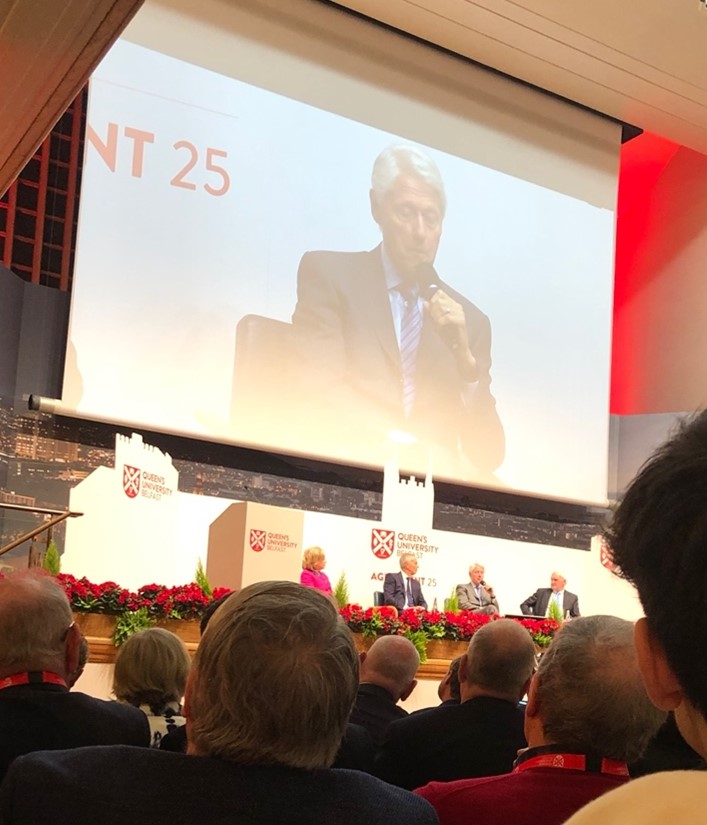
Secretary Hillary Clinton chairing a panel with U.S. President Bill Clinton, U.K. Prime Minister Tony Blair, and Irish Taoiseach Bertie Ahern, the leaders of the involved state governments at the time of the Agreement’s signing.